
The Journal · 9 min read
How to Address Wedding Invitations (UK): Envelope Etiquette for Couples, Families and Plus Ones
By Beth, founder of Graceful Studio · Updated
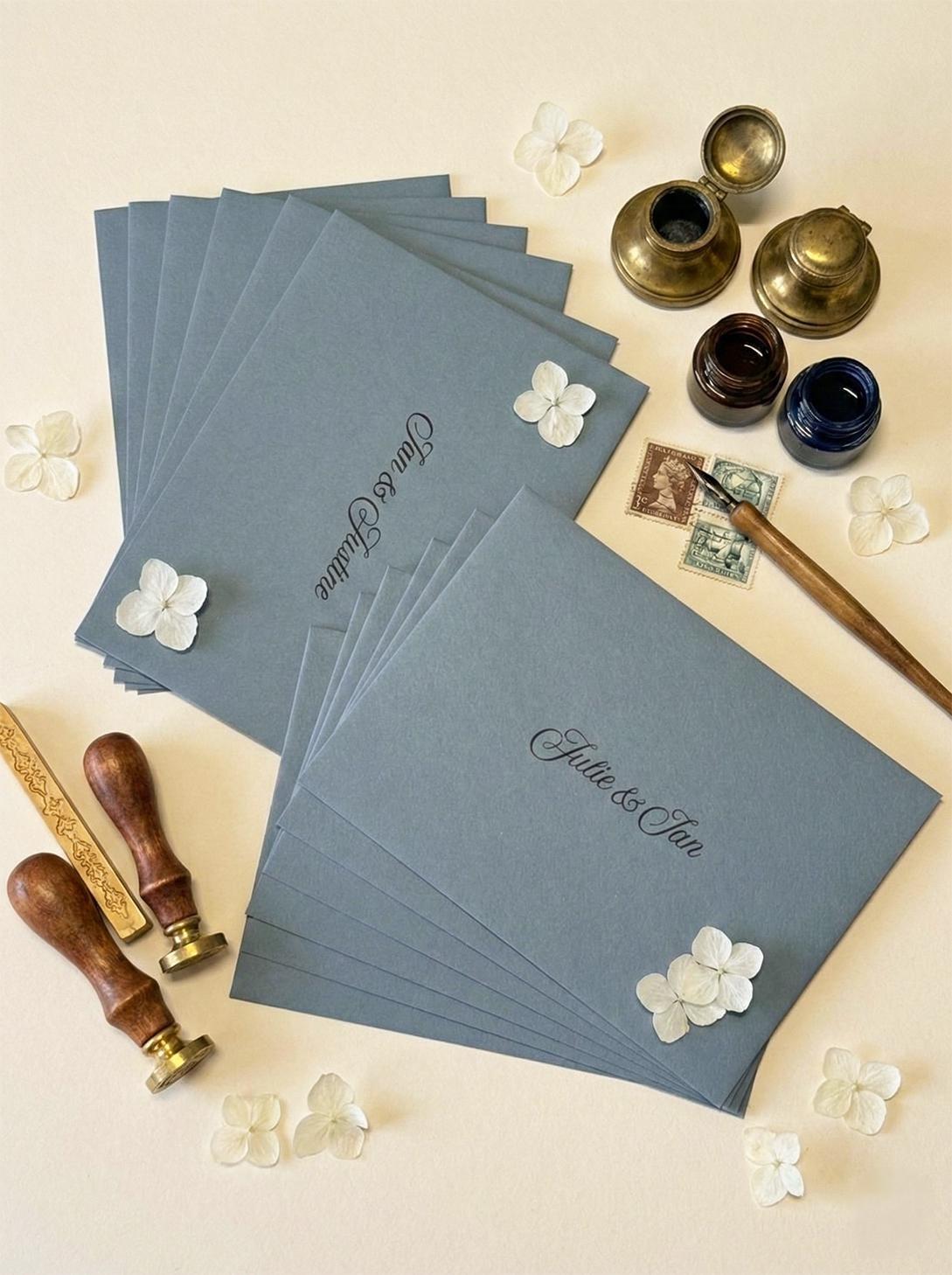
The envelope is the very first thing your guests see, and it quietly answers their biggest question before they’ve even opened it: who’s invited? Knowing how to address wedding invitations properly saves awkward phone calls later about children, partners and plus ones. This guide covers UK etiquette for every kind of guest, with exact examples of how each envelope should read, so you can copy them straight onto your list.
The golden rules of addressing wedding invitations
- The names on the envelope are the invitation. Anyone not named isn’t invited. That’s why it matters so much.
- One invitation per household. A couple, or a family living together, shares one envelope.
- Write names in full. “Emma and John Smith”, never “The Smiths” or “Emma + partner”.
- Be consistent. Choose formal titles or first names and use the same style for every guest.
- No full stops after titles. In British English it’s Mr, Mrs, Ms and Dr, not Mr. or Dr.
- Check spellings. Double-check double-barrelled surnames, new married names and how people actually spell their names.
How to address wedding invitations to a married couple
There are three accepted ways to address a married couple in the UK, from very formal to relaxed. None is wrong; just pick the one that suits your invitation wording and use it throughout.
Traditional
The classic British form uses the husband’s first name for both. It’s still used for formal weddings and older relatives, but many women now find it old-fashioned, so think about who’s receiving it.
Mr and Mrs John Smith
Modern
The modern formal version gives both people their own first name. It keeps the titles but feels much more equal:
Mr John and Mrs Emma Smith
For a relaxed wedding, drop the titles altogether. Lead with whoever you know best:
Emma and John Smith
Married couples with different surnames
If one of them kept their own name, write both names in full. Put the person you know best first, or go alphabetically by surname if you’re not sure. If the names are long, give each person their own line.
Ms Emma Jones and Mr John Smith
Dr Charlotte Whitworth-Price
Mr Daniel Okafor
Same-sex couples
Exactly the same rules apply. If they share a surname, give both first names; if they don’t, write each name in full. Leading with the person you know best is perfectly polite.
Mr Tom and Mr Ben Hughes
Mrs Priya Patel and Mrs Sarah Collins
How to address wedding invitations to an unmarried couple
An unmarried couple living together gets one invitation with both names on it, on one line or two. There’s no need to use “and partner”: name them both, so your guest feels like a guest rather than a plus one.
Miss Lucy Brown and Mr Sam Carter
Lucy Brown and Sam Carter
For a couple who don’t live together, the formal approach is a separate invitation to each at their own address. Most couples now simply send one invitation to the person they know best, with both names on the envelope. Either is fine; one invitation is easier to keep track of when the RSVPs come back.
How to address wedding invitations to a family
This is the one that causes the most confusion. The simple rule: name every child who’s invited, on the line below their parents. Avoid writing “and family”. It sounds friendly, but it leaves guests guessing: does it include the 19-year-old? Their boyfriend? Grandma, who lives with them?
Emma and John Smith
Olivia, Jack and Rosie
Mr and Mrs John Smith
Miss Olivia Smith and Master Jack Smith
In the formal version, girls are “Miss” and young boys are traditionally “Master”, although Master is rarely used now and most couples just give children’s first names. If the parents have different surnames, write both in full and add the children underneath:
Emma Jones and John Smith
Olivia and Jack
Adult children
Children aged 18 and over should get their own invitation, even if they still live at home. It’s the polite way to treat them as adult guests, and it means they reply for themselves. If they have a partner you’re inviting too, put both names on their envelope.
Miss Olivia Smith
How to address a wedding invitation with a plus one
If you know who your guest is bringing, always use their name. It’s warmer, and it means you’ll have the right name for the seating plan and place cards later. A quick message asking “Who will you be bringing?” is completely normal.
Miss Lucy Brown and Mr Tom Reed
If they haven’t decided yet, or you’d rather leave it open, “and Guest” is the accepted form. Never write “and partner” unless you know they have one.
Miss Lucy Brown and Guest
Titles: Mr, Mrs, Ms, Miss, Mx, Dr and Reverend
If you’re using formal titles, here’s how each one reads on a UK envelope. When in doubt, use the title the guest uses themselves.
| Guest | How to write it | Notes |
|---|---|---|
| Married woman | Mrs Emma Smith | Use her own first name unless you’re going fully traditional |
| Woman, any marital status | Ms Emma Jones | A safe, polite choice if you’re unsure |
| Unmarried woman | Miss Emma Jones | Traditional for younger women; Ms is often preferred now |
| Non-binary guest | Mx Alex Taylor | Pronounced “mix”; or simply use their full name with no title |
| Doctor | Dr Emma Smith | Medical doctors and PhDs alike; no full stop |
| Two doctors | Dr Emma Smith and Dr John Smith | Or “Drs Emma and John Smith” for a shorter line |
| One doctor in a couple | Dr Emma Smith and Mr John Smith | The person with the title doesn’t have to go first |
| Clergy | The Revd John Smith and Mrs Smith | “The Reverend” in full is also correct |
| Professor | Professor Emma Smith | Write it out in full rather than “Prof” |
For military ranks, peers and other titled guests, follow the forms of address the guest uses in their own correspondence, or check a guide such as Debrett’s. It’s worth getting right for these few.
Widowed, divorced and single guests
Widowed women traditionally keep their husband’s name in the formal style, so “Mrs Robert Wilson” is still correct for an older guest who uses it. Most widows today are addressed with their own first name. If you’re not sure, ask a family member which she prefers.
Mrs Margaret Wilson
Mrs Robert Wilson
Divorced women are never addressed with their former husband’s first name. Use “Mrs” or “Ms” with her own first name and whichever surname she now uses. Single guests simply get their own name, plus “and Guest” or a named partner if you’re offering a plus one.
Ms Claire Bennett
Addressing evening invitations
Evening guests follow exactly the same rules as day guests: one invitation per household, every invited person named. Use the same style of names as your day invitations so the two sets match, and send them at the same time (our timeline guide has the dates).
Many evening invitations are handed out at work or at the school gate rather than posted. For a hand-delivered invitation, write the names only, with no address. First names are fine for colleagues and friends:
Hannah and Chris
Inner and outer envelopes: do you need them in the UK?
Inner and outer envelopes are mainly an American tradition. The outer envelope carries the formal names and postal address, and a second, unsealed inner envelope inside lists everyone invited, often more informally (“Grandma”, “Olivia and Jack”). It dates from a time when outer envelopes could arrive grubby from the post.
In the UK they’re rare, and you don’t need them. A single envelope with every invited guest’s name on the front does both jobs. If you love the layered look, a vellum wrap or a ribbon around the invitation gives the same sense of unwrapping, without doubling your envelope count.
How to write the address on a wedding invitation
Royal Mail’s machines read addresses best when they follow a set order. Write the names on the first line, then each part of the address on its own line, and the postcode on the last line by itself. Put the post town in capitals. You don’t need commas at the ends of lines, and you don’t need the county as long as the postcode is right.
Mr and Mrs John Smith
14 Orchard Close
Little Haddon
BRISTOL
AB12 3CD
Centre the address slightly below the middle of the envelope, leaving the top right corner clear for the stamp. For a guest overseas, write the country in capitals on the very last line, after their local postcode or town:
Ms Claire Bennett
8 Rue des Lilas
75011 PARIS
FRANCE
Do you put a return address on wedding invitations?
It isn’t a UK tradition to print a return address on the front, and you don’t need one. That said, it’s sensible to add your address on the back flap, so anything that can’t be delivered finds its way home rather than going missing. A small, neat line on the back doesn’t spoil the look:
If undelivered, please return to:
Emma Jones
3 Mill Lane
LEEK
AB1 2CD
If you’d rather keep the envelope completely clean, make sure your RSVP card or details card carries an email address or phone number, so a guest with a wrongly addressed invitation can still let you know.
Should you hand write wedding invitation envelopes?
Handwritten envelopes are lovely and perfectly correct. If you’re writing them yourself, use a fine-tipped pen in black or dark ink, practise on spares first, and rule a faint pencil guideline you can rub out afterwards. Allow more time than you think: at around three minutes an envelope, 60 envelopes is three hours of careful writing.
If your handwriting isn’t something you want on show, or you’d rather spend that evening elsewhere, we can print your guests’ names and addresses on your envelopes. We usually print in the same font as your invitation (or the closest match to a font you love), so the envelope and the card inside look like one set. You send us your list, and we can print just names for hand-delivered invitations, or names and full addresses for posting.
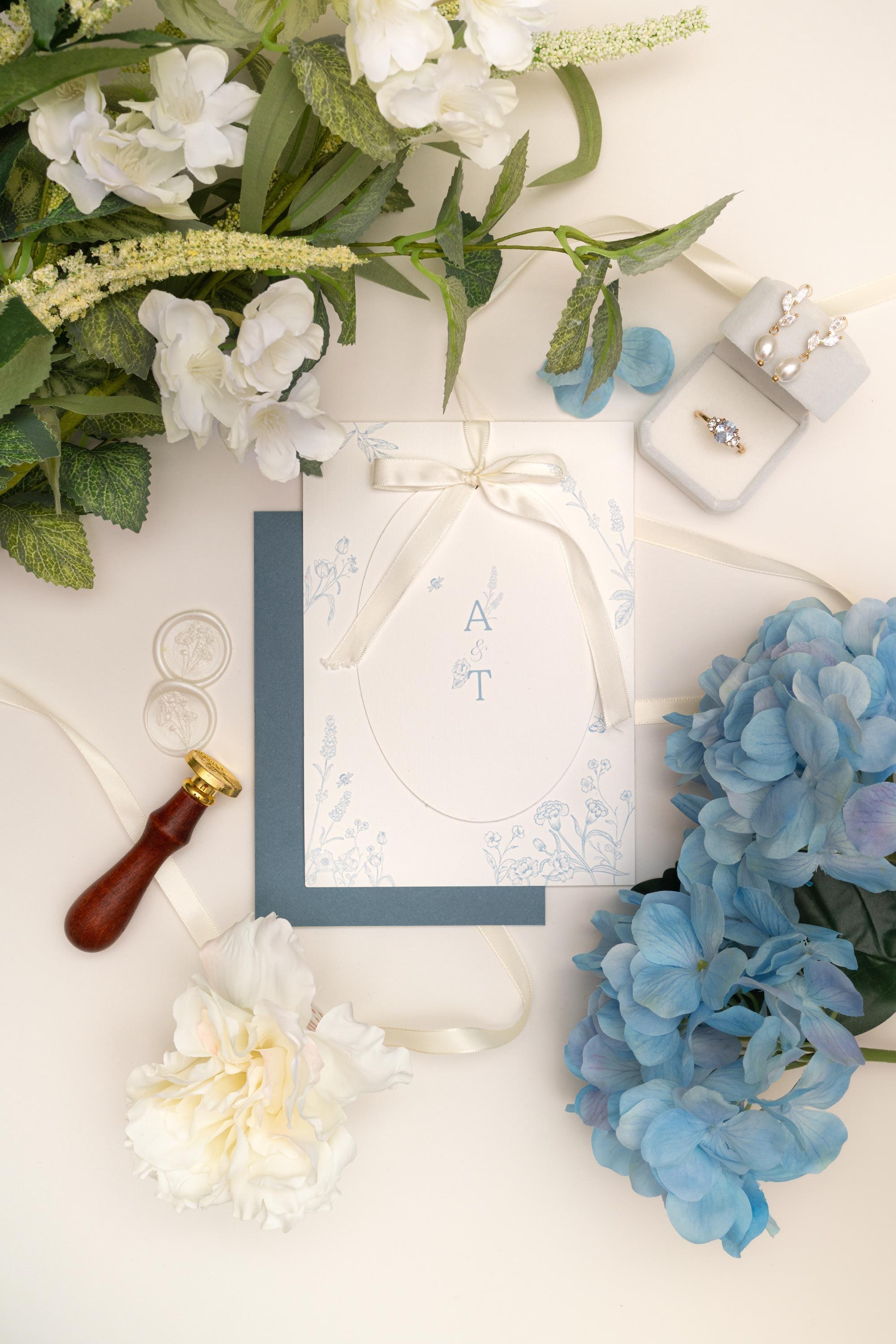
At the time of writing, envelope printing costs £0.80 per envelope when you order it with your invitations, or £1 per envelope including the envelope if you’re ordering them on their own, even if your invitations came from somewhere else. Most couples choose black ink, though we can print in other colours (not white or metallics). Check current prices on the product page and lead times on our delivery page.
Common addressing mistakes to avoid
- Writing “and family” when you only mean the children under 18.
- Using “and Guest” when you could easily find out the partner’s name.
- Mixing styles, with titles on some envelopes and first names on others.
- Forgetting a separate invitation for adult children living at home.
- Missing postcodes, or squeezing the postcode onto the same line as the town.
- Addressing a divorced guest by her former husband’s first name.
- Leaving the envelopes until the last week. Write or order them alongside your invitations.
Once the invitations are out, the same careful addressing applies to your thank you cards after the wedding; our guide to wedding thank you card wording covers what to write inside. And if you’re still counting envelopes, our wedding stationery checklist shows how many to order.
Envelopes and invitations to match
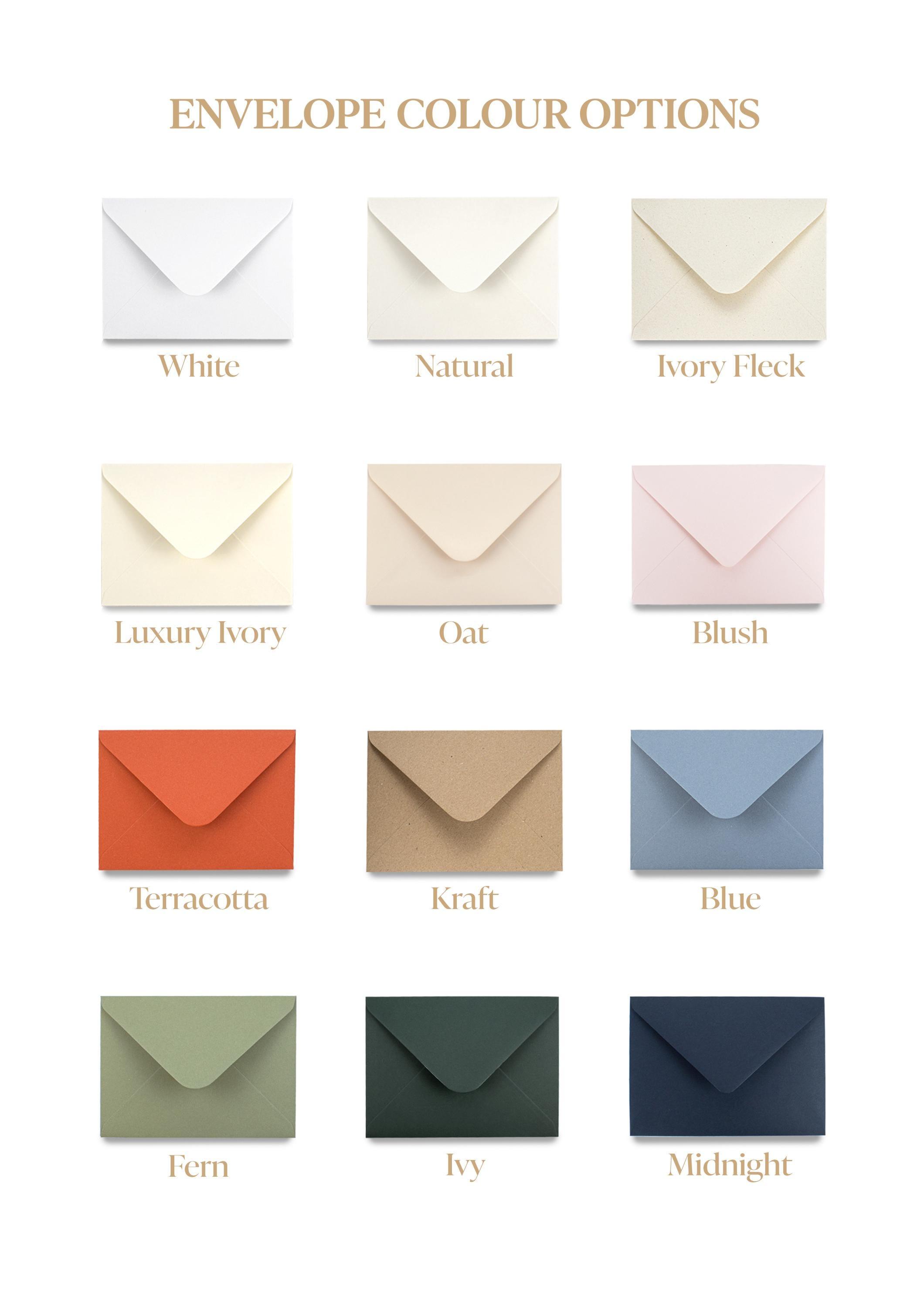
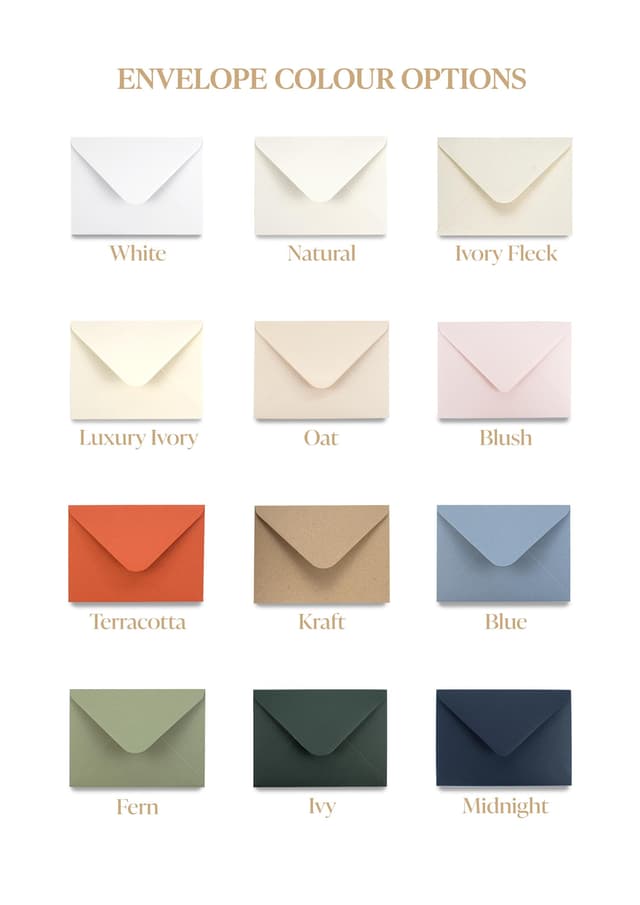
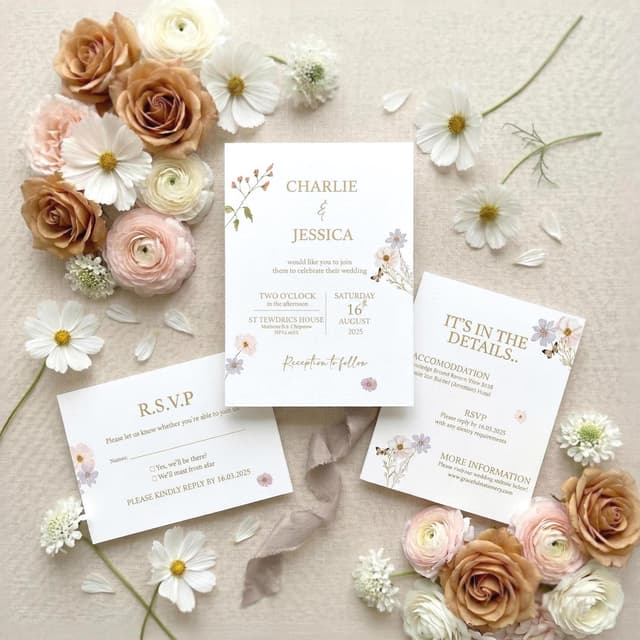
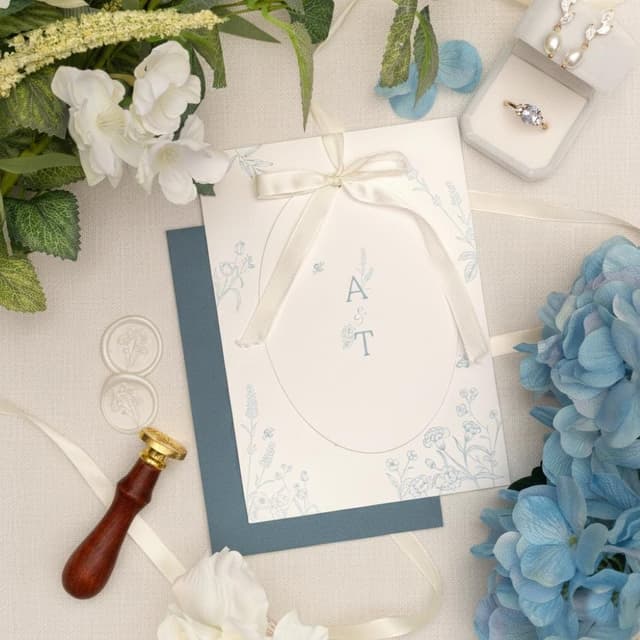
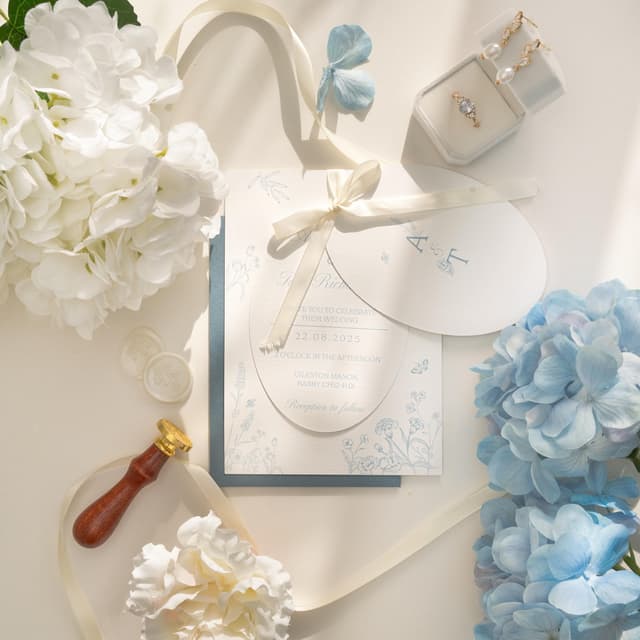
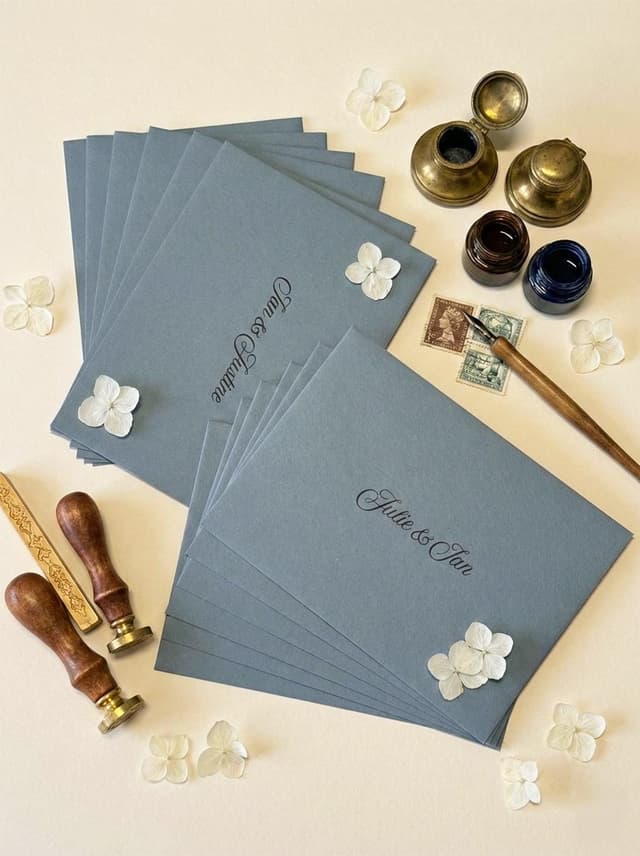
We offer twelve envelope colours, from white and ivory to fern, ivy and midnight, and we can add printed names and addresses in the same font as your invitation. Here are a few favourites to start with:
Frequently asked questions
How do you address a wedding invitation to a married couple?
+
Traditionally “Mr and Mrs John Smith”. A modern formal version is “Mr John and Mrs Emma Smith”, and for a relaxed wedding “Emma and John Smith” is fine. If they have different surnames, write both names in full, such as “Ms Emma Jones and Mr John Smith”.
How do you address a wedding invitation to a family?
+
Write the parents’ names on the first line and the children’s first names on the line below, for example “Emma and John Smith” then “Olivia, Jack and Rosie”. Avoid “and family”, and send children aged 18 and over their own invitation.
How do you address a wedding invitation to an unmarried couple?
+
If they live together, send one invitation with both full names, such as “Miss Lucy Brown and Mr Sam Carter” or “Lucy Brown and Sam Carter”. If they live apart, you can send one to each, or one to the person you know best with both names on it.
How do you address a wedding invitation with a plus one?
+
Use the plus one’s name if you know it, for example “Miss Lucy Brown and Mr Tom Reed”. If you don’t, write “Miss Lucy Brown and Guest”. Avoid “and partner” unless you know they have one.
Do you put a return address on wedding invitations in the UK?
+
It isn’t a UK tradition and it isn’t required, but a small return address on the back flap is sensible so undeliverable invitations come back to you. Never put it on the front.
How do you address a wedding invitation to a widow?
+
Most widows are addressed with their own first name, such as “Mrs Margaret Wilson”. The traditional form, “Mrs Robert Wilson”, is still correct for an older guest who uses it. If you’re unsure, ask the family which she prefers.
Should you hand write wedding invitation envelopes?
+
Handwritten envelopes are perfectly correct and look lovely, but they take time: allow around three minutes each. Printed guest names in the same font as your invitation are a neat alternative, especially for a long guest list.
Do you need inner and outer envelopes for wedding invitations?
+
Not in the UK. Inner and outer envelopes are mainly an American tradition. A single envelope with every invited guest’s name and the postal address on the front is all you need.
More from the Journal
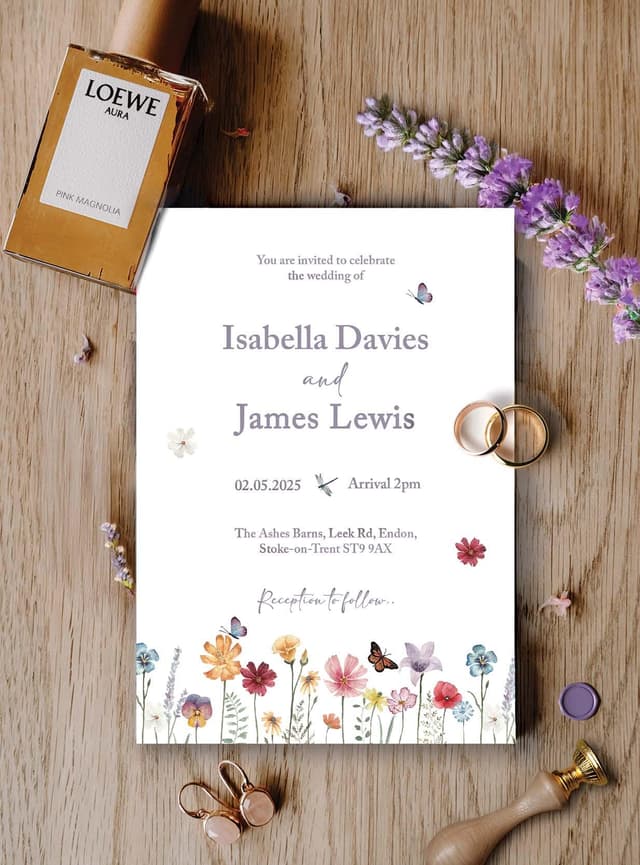
8 min read
Evening Wedding Invitation Wording (UK): Examples, Etiquette and What to Write
Evening wedding invitation wording for UK weddings: formal, relaxed and fun examples, what to write, timings, and RSVPs for evening guests.
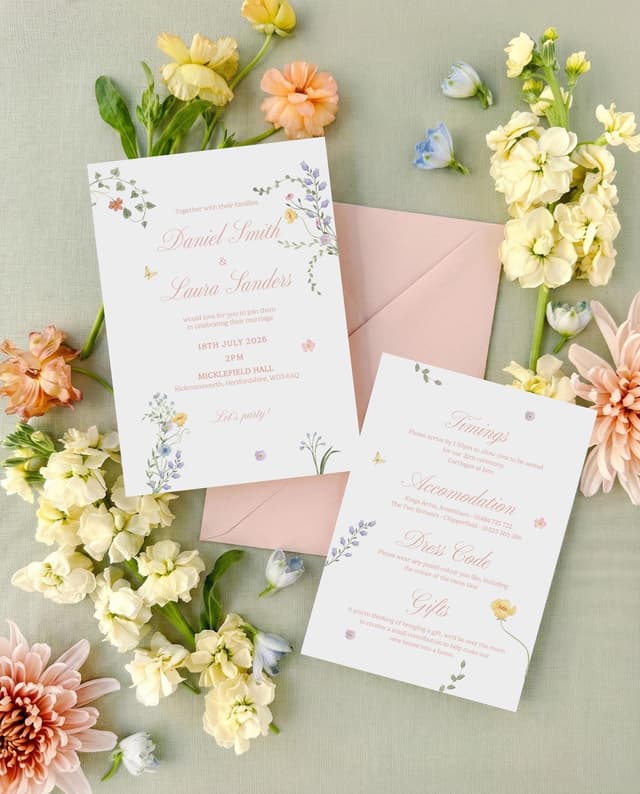
6 min read
How to Word No Children at a Wedding: Polite Adults-Only Wording (UK)
How to word no children at a wedding politely: where to say it, adults-only wording for invitations, details cards and websites, and what to say if asked.
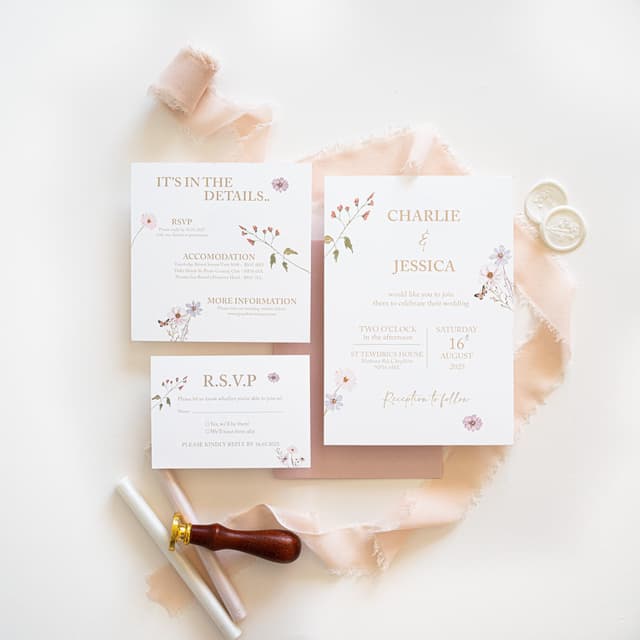
7 min read
RSVP Wording for Weddings (UK): Examples for RSVP Cards, Wedding Websites and Polite Reminders
RSVP wording for weddings: UK examples for RSVP cards, menu choices, dietary needs, plus ones, song requests and QR codes, and how to chase late replies.
7 min read
How Many Wedding Invitations Do I Need? A Step-by-Step Calculator for 30 to 200 Guests
How many wedding invitations do you need? Count households, not guests: a step-by-step method, tables for 30–200 guests, spares, evening invites and RSVPs.
8 min read
Dusty Blue Wedding Ideas: Colour Palettes, Decor and Stationery for a Dusty Blue Wedding Theme
Dusty blue wedding ideas: colour palettes that pair with dusty blue, flowers, table decor, bridesmaids, and dusty blue wedding invitations, menus and envelopes.
6 min read
Autumn Wedding Stationery Ideas: Invitations, Colours and Table Stationery for a UK Autumn Wedding
Autumn wedding stationery ideas: autumn colour palettes, invitation motifs, envelope colours, wax seals, when to send invitations, and ideas for barn weddings.
6 min read
Wax Seal Wedding Invitations, Vellum and Ribbon: The Finishing Touches Explained
Wax seal wedding invitations, vellum wraps and ribbon explained: self-adhesive vs traditional wax, seal colours, satin vs silk ribbon and UK postage.
9 min read
How to Assemble Wedding Invitations: Stacking Order, Vellum, Ribbon and Wax Seals, Step by Step
How to assemble wedding invitations step by step: the stacking order, which way cards face, vellum, ribbon, wax seals, RSVP cards and the envelope, with timings.
6 min read
Wedding Invitation Samples: Why to Order Them First and What to Look For in a Sample Pack
Why order wedding invitation samples first: what’s in a sample pack, standard vs personalised samples, how to judge one, and when to order.
7 min read
Bespoke vs Semi-Custom Wedding Stationery: Which Is Right for You?
Bespoke wedding stationery or semi-custom? An honest UK comparison of cost, time, proofs and uniqueness, what you can change, and questions to ask a stationer.
8 min read
Destination Wedding Invitations (UK): Timeline, What to Include and Wording Examples
Destination wedding invitations for UK couples marrying abroad: when to send them, what to include, copyable wording examples, design ideas and posting tips.
7 min read
Wedding Place Card Ideas: Styles, Sizes, Wording and How to Lay Them Out
Wedding place card ideas for UK couples: flat, tent and named menu styles, meal markers, sizes, what to write, children’s cards and how to lay them out.
6 min read
How Much Do Wedding Invitations Cost in the UK? Real Prices and Worked Examples for 100 Guests
How much do wedding invitations cost in the UK? Real prices per invite and per guest, costed examples for 100, 150 and 200 guests, postage and ways to save.
7 min read
Wedding Menu Wording Ideas: Example Menus, Dietary Symbols and Menu Card Ideas (UK)
Wedding menu wording examples to copy: three-course, sharing, alternate drop, choice, evening and drinks menus, plus dietary symbols, sizes and place card ideas.
8 min read
Wedding Table Name Ideas: 17 Themes and 200+ Names to Use Instead of Numbers
Over 200 wedding table name ideas instead of numbers: wildflowers, UK places, travels, love words, songs, films, drinks and more, plus how to choose them.
9 min read
Wedding Seating Plan Ideas (UK): How to Plan Who Sits Where, Top Table Etiquette and Board Layouts
Wedding seating plan ideas for UK couples: how to plan who sits where, top table etiquette, round vs long tables, alphabetical vs by-table boards and sizes.
10 min read
How to Ask for Money as a Wedding Gift: Polite Wording and Poems (UK)
How to politely ask for money as a wedding gift in the UK: where to put it, copy-and-paste wording, short and funny poems, plus no gifts and charity wording.
6 min read
What to Put on a Wedding Details Card: Wording Examples, Size and a Full Example
What to put on a wedding details card: accommodation, travel, timings, dress code, gift list, RSVP and QR code, plus wording examples, a full example and sizes.
8 min read
Save the Date Wording (UK): What to Write, With 25+ Examples
UK save the date wording examples: classic, relaxed, funny, destination and evening guests, plus what to put on a save the date, who gets one and when to send it.
7 min read
Wedding Stationery Trends 2027: The Invitations, Colours and Details Couples Are Choosing
Wedding stationery trends 2027 from our UK studio: wildflowers, dusty blue toile, ovals, satin bows, wax seals, vellum, named menus and 2027 colour schemes.
9 min read
What to Write in a Wedding Thank You Card: UK Wording Examples for Every Guest
What to write in a wedding thank you card: UK wording examples for money, gifts, parents, guests who didn’t attend, no gift, and when to send them.
5 min read
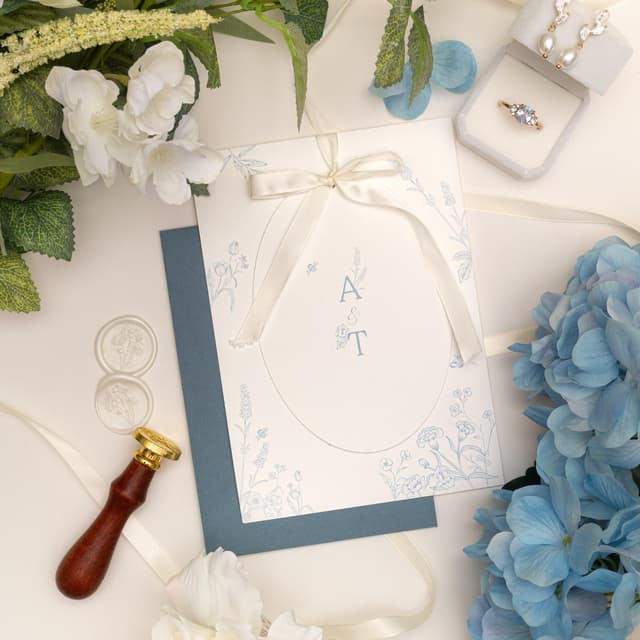
How to Choose Wedding Invitations: A UK Guide to Style, Size, Paper and Finishing Touches
How to choose wedding invitations in the UK: matching the style to your venue, picking colours, standard invitation sizes (5×7, A5 or A6), paper weight, wax seals, vellum and ribbon, and how to check your proof.
5 min read
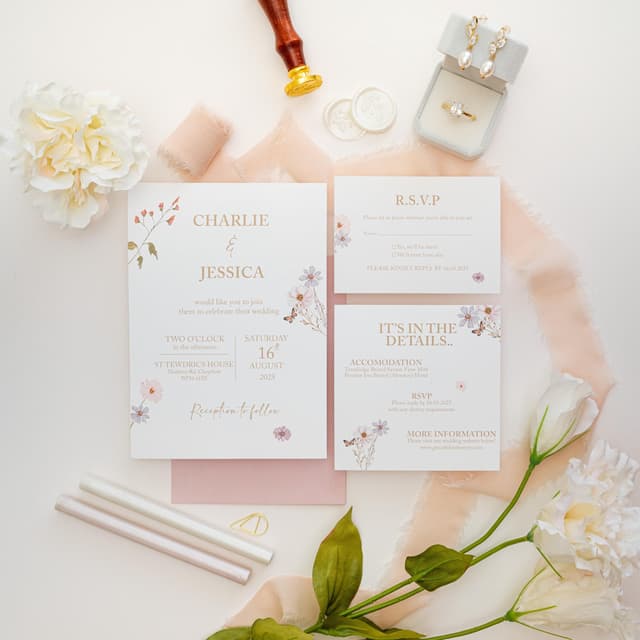
The Wedding Stationery Checklist (UK): What You Need, What’s Optional and How Many to Order
A complete UK wedding stationery checklist: what you really need, what’s optional on the day, what to skip, and exactly how many invitations, RSVPs, menus and place cards to order, with a worked example.
5 min read
Wedding Invitation Wording Examples (UK): Formal, Relaxed & Everything Between
Copy-and-paste UK wedding invitation wording for every situation: couples hosting, parents hosting, church and civil ceremonies, evening receptions, destination weddings, plus RSVP and details card wording.
3 min read
When to Send Wedding Invitations in the UK (Plus Save the Dates & RSVPs)
When to send save the dates, wedding invitations and evening invitations in the UK, when to set your RSVP date, and when to order your stationery, with a month-by-month timeline and worked examples.
3 min read
Wildflower Wedding Stationery Ideas: From Invitations to the Table
Wildflower wedding stationery ideas for a meadow-inspired day: colour palettes, envelope pairings, matching menus, table numbers and place cards, seasonal UK flowers and finishing touches.